
Table of Contents
- Start by Understanding What Depression Actually Feels Like
- What to Say to Someone with Depression
- What Not to Say to Someone with Depression
- How to Encourage Someone with Depression to Get Help
- How to Help Someone with Depression Who Refuses Help
- Practical, Day-to-Day Ways to Support Someone with Depression
- When to Step In: Recognizing a Crisis and Finding Support
- Looking After Yourself While You Support Someone with Depression
- Frequently Asked Questions
Last Updated: October 22, 2026
Start by Understanding What Depression Actually Feels Like
Depression is more than sadness.
That gap between "I care" and "I can't reach you" explains why support often misses. You offer solutions.
Here is what most guides get wrong: they treat depression like a problem to fix. It is not.
- Sadness lifts with distraction. Depression does not.
- Low energy is not laziness. It is a symptom.
- Withdrawal is not rejection. It is self-protection.
The NHS overview of depression symptoms is a useful starting point for understanding what your person may be facing.
What to Say to Someone with Depression
Say less than you think you should. The best opening is a simple, specific offer of presence. "I'm here, and I'm not going anywhere" lands better than a speech.
People with depression often feel like a burden. Your job is to reduce that feeling, not add to it.
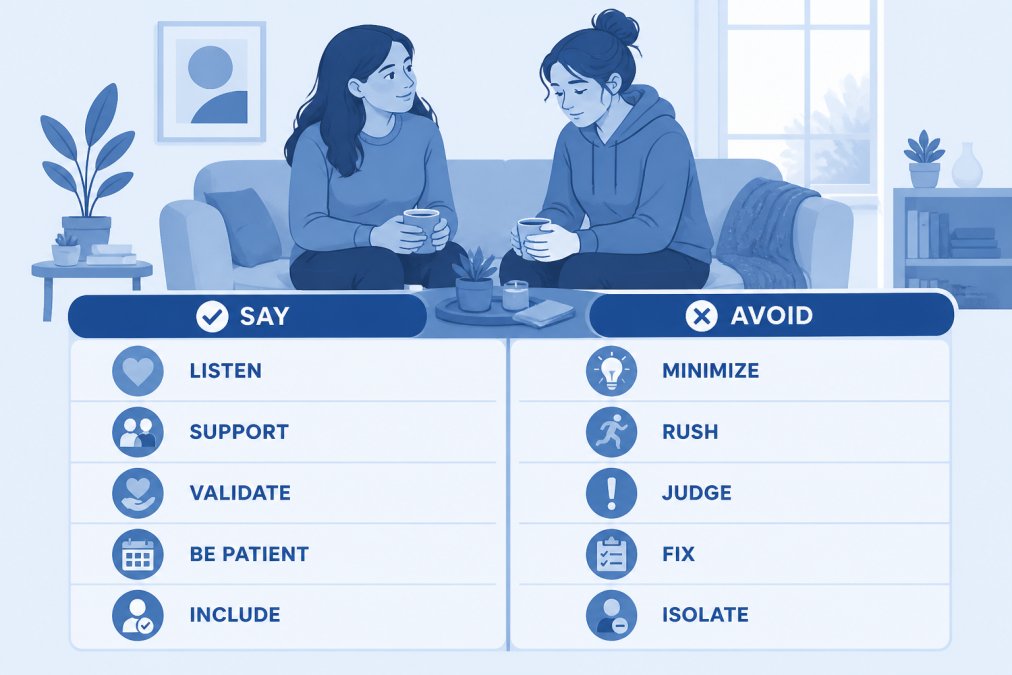
Conversation starters that open the door
Use low-pressure questions. They invite honesty without demanding it.
- "How are you really doing today?"
- "Want to talk, or want company with no talking?"
- "I noticed you've been quiet. I'm not going anywhere."
Then stop talking. Active listening means letting silence do its work. No fixing, no rushing, no judgment.
What Not to Say to Someone with Depression
Some well-meaning phrases do real damage. Avoid anything that implies the person could simply choose to feel better.
Skip these:
- "Just think positive."
- "Others have it worse."
- "You have so much to be grateful for."
Each one adds shame to an already heavy load. Criticism and blame push people further into isolation.
The alternative is validation. "That sounds exhausting. I'm sorry you're carrying it" says you believe them. That is worth more than advice.
How to Encourage Someone with Depression to Get Help
Encouraging professional help works best as a shared step, not a verdict. Frame it as an addition to their support network, not a sign they have failed.
When to bring up professional support
Raise the topic when symptoms last more than two weeks, or when daily life starts slipping: missed work, poor sleep, withdrawal from friends.
Try this approach:
- Name what you see: "You've seemed really worn down lately."
- State your care: "I'm worried because I love you."
- Offer a concrete step: "Can I help you book an appointment?"
- Remove the barrier: "I'll drive you, and we can get lunch after."
The NHS guide to talking therapies and referrals explains what treatment usually involves, which can make the first step feel less unknown.
Treatment adherence matters too. If a friend starts therapy or medication, gentle follow-up helps: "How did the appointment go?" Consistency keeps momentum going.
How to Help Someone with Depression Who Refuses Help
Refusal is common, and it is rarely permanent. Respect it, stay connected, and keep the door open. Pushing too hard can break trust.
What works better:
- Keep inviting them, even when they decline.
- Drop the subject, not the person.
- Share your concern once, clearly, then let it rest.
If symptoms persist and help stays refused, involve a trusted family member or their GP. Never force, but never disappear either.
Practical, Day-to-Day Ways to Support Someone with Depression
Daily tasks are where depression bites hardest. Cooking, laundry, and messages can feel impossible. Practical assistance lifts real weight.
Offer specifics, not open questions. "Can I bring dinner Thursday?" beats "Let me know if you need anything."
Carry Kindness Tote Bag – Mental Health & Neurodiversity Awareness Organic →
Small gestures that carry weight
- Drop off groceries with no expectation of a visit.
- Send a text with no reply required: "Thinking of you."
- Take the kids for an afternoon.
Healthy routines help too. Gentle nudges toward sleep, food, and movement support recovery without pressure. A small, tangible reminder can also help. Our Quietly Seen journal gives someone a private space for thoughts at their own pace, and our One Sip, One Breath mug carries a simple daily message: one thing at a time.


When to Step In: Recognizing a Crisis and Finding Support
Some signs need immediate action. Take them seriously, every time. This is the part of support where being specific matters most, so treat the steps below as a short protocol rather than a list of suggestions.
Warning signs that warrant a direct conversation today
- Talk of wanting to die, disappearing, or being a burden to others
- Withdrawal from everyone and everything, especially after a period of reaching out
- Giving away possessions, writing notes, or saying goodbye in a way that feels final
If you see several of these together, do not wait for a "better moment." A common pattern is that supporters wait for certainty and the window closes.
Ask directly, then listen to the answer
Ask plainly: "Are you thinking about suicide?" Asking does not plant the idea. Research and clinical guidance consistently find that direct questions do not increase risk and often bring relief, because the person no longer has to carry the thought alone.
Follow up with two questions that change what you do next:
- "Are you thinking about it right now?"
- "Do you have a plan, and do you have access to what you'd need?"
A yes to either of the follow-ups means imminent risk. A no to both, with passive thoughts only, still means the person needs professional support soon, but the urgency is different.
If risk is imminent
- Stay with them. Do not leave, even to "give them space." If you must move, go together.
- Remove access to means where you safely can, medication, sharp objects, car keys, and ask them to hand items over rather than taking them.
- Call emergency services. In the UK, call 999 or take them to A&E. In the US, call or text 988. If you are elsewhere, use your local emergency number.
If thoughts are present but risk is not imminent
Make a same-week plan, not a someday plan. Help them contact their GP or clinician, sit with them while they call, and agree on a check-in time within 24 hours. The Samaritans free 24/7 listening service is available any hour for both of you, and the NHS urgent mental health guidance explains which service to use when.
After the crisis passes
Follow up. A short message the next day, "I'm glad you're here. How are you this morning?", matters more than a long debrief. Ask what helped and what didn't, and write down the crisis numbers together so the plan is not dependent on memory during a bad night.
Looking After Yourself While You Support Someone with Depression
Supporting someone is a long road, and you cannot pour from an empty cup. Caregiver wellbeing is not selfish. It is what keeps you steady enough to be useful. Most guides stop at "take care of yourself." This section gives you an actual plan.
Know the signs you are running low
Supporter burnout rarely arrives all at once. A common pattern looks like this:
- You feel resentful, then guilty about feeling resentful
- You are sleeping badly or checking your phone through the night
- You have stopped seeing your own friends
Any two of these together is a signal to adjust, not to push harder.
Set boundaries you can actually hold
A boundary is not a rejection. It is a statement of what you can sustain, so you do not disappear later. Say it once, kindly, and mean it:
- "I can talk after 7pm, but I can't answer during work hours."
- "I can't be your only person. Let's find one more person you can call."
- "I love you, and I'm not able to talk about this tonight. Can we pick it up tomorrow?"
If a boundary is met with anger, that is information, not a reason to abandon it. Hold the line and revisit it when things are calmer.
Build a respite plan, not a resolution
Write down three things and keep them where you can see them:
- One weekly commitment that is yours, a class, a walk, a call with a friend, that does not move when the person you support has a hard week.
- One backup person you can text when you are overwhelmed, who is not the person you are supporting.
- One professional you can contact, your own GP, a therapist, or a carer support line, for when the load is beyond what friends can hold.
Protect the basics
Sleep, food, and movement are not luxuries when you are a supporter; they are the floor you stand on. A short daily walk, a fixed bedtime, and eating at roughly the same time each day do more for your capacity than any single act of willpower.
Get support for yourself
Tell a trusted friend what you are carrying, in specifics rather than in general terms. If you are in the UK, your GP can point you to carer support, and the Samaritans free 24/7 listening service is there for supporters too, not only for people in crisis.
If you want a gentle reminder of your own worth, our Carry Kindness tote carries the message that every mind deserves room. Small, everyday pieces like these help supporters and their loved ones feel less alone.

Frequently Asked Questions
What are three simple ways I can support someone who is experiencing depression?
Start with listening without judgment: let them talk and resist the urge to fix things. Second, offer concrete practical help, like bringing a meal, running an errand, or sitting with them during a difficult afternoon. Third, keep showing up consistently. A short text, a walk together, or an invitation that doesn't demand a response all signal that they matter and that you're not going anywhere. These small, steady actions often mean more than a single big gesture.
What should I do if someone with depression talks about suicide?
Take it seriously and stay calm. Ask directly whether they are thinking about suicide and whether they have a plan. Listen without panic or judgment. If there is immediate danger, do not leave them alone and contact emergency services. In the US, you can call or text 988 to reach the Suicide and Crisis Lifeline at any time. Encourage them to speak with a professional as soon as possible, and check in afterward. Asking about suicide does not plant the idea; it opens a door.
How do I encourage someone with depression to seek professional help without pushing too hard?
Frame it as care rather than correction. Mention that therapy and treatment can help with the exhaustion and heaviness they're carrying, not that they're broken. Offer to help with the practical side: finding a therapist, making the first call, or driving them to an appointment. If they hesitate, leave the door open and revisit gently later. Respect their pace while being clear that you believe support would help.
How can I help someone with depression who refuses help?
Keep the relationship warm and low-pressure. Continue offering practical support and company without tying it to treatment. Share your concern once, clearly and kindly, then focus on staying connected. Set gentle boundaries around what you can do, and watch for signs of crisis. If their safety becomes a concern, involve emergency services. You cannot force someone into recovery, but consistent presence and a calm, nonjudgmental stance often make it easier for them to accept help when they're ready.
Supporting someone with depression is hard, and you will not always get it right. That is normal. What matters is showing up, listening without judgment, and staying kind, to them and to yourself. At Quietly Seen, we make everyday pieces that carry gentle reminders of self-kindness and belonging, from our organic cotton tote to our ceramic mug and journal. Get started with Quietly Seen and carry a little more compassion into every ordinary day.